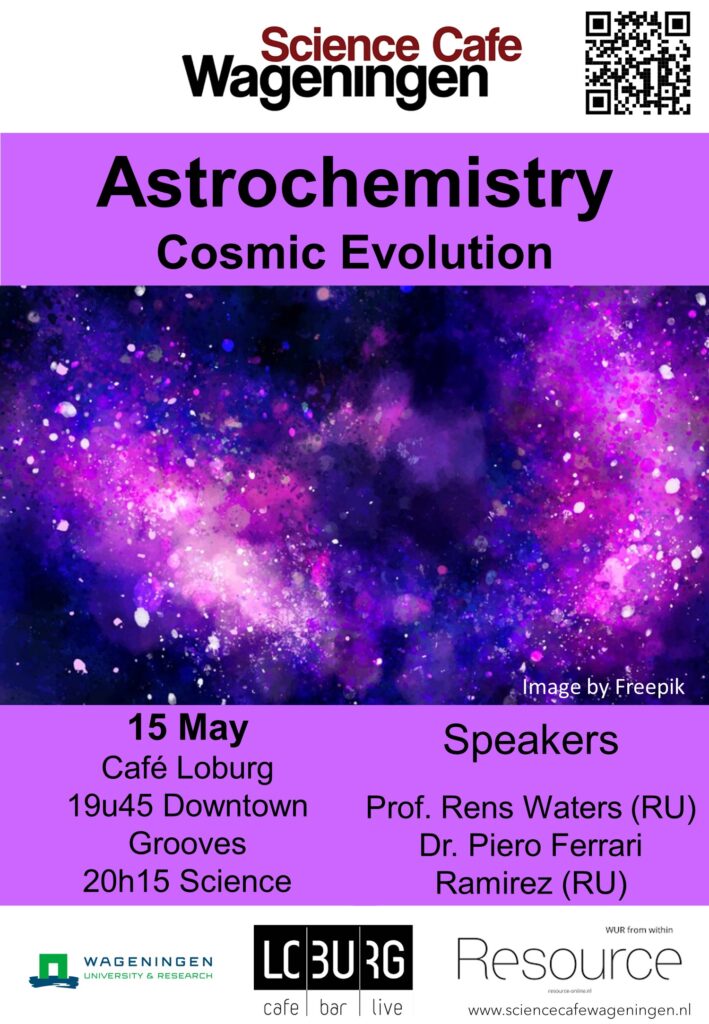
Wednesday May 15
19:45 live music: Downtown Grooves
20:15 speakers
Café Loburg
Astrochemistry, cosmic evolution
How did the Universe begin? You probably learned at school: with “The Big Bang”, a long time ago… But what exactly is the universe made off and how did the gasses and particles that stars, planets and we are made off actually form and develop? Come and find out in this exciting science café on Astrochemistry! Technological advances in spectroscopy and high resolution telescopes allowed for new discoveries of molecules in our solar system and beyond, complemented with experimentation on Earth. In this Science Café we explore the state-of-the art knowledge on Astrochemistry. We dive into what astrochemistry is, the use of novel telescopes and how astrochemistry can teach us more about the evolution of the cosmos and the origin of life. Our first speaker, Prof. Rens Waters will explain what Astrochemistry entails and how it can help us understand cosmic evolution. Our second speaker, Dr. Piero Ferrari, will discuss how the composition of the cosmos is measured and how that information is used on experiments on Earth, to reveal the behaviour and evolution of elements and molecules in space.
Prof. Rens Waters is Professor in Astrophysics at Radboud University with a focus on Molecular-astrochemistry and Exoplanets. His research focuses on the formation of stars and planets, the study of planet-forming disks that surround all young stars. He also investigates the nature and composition of exoplanets and their atmospheres. His expertise comprises the chemical and physical properties of solids in space. These solids play an important role in interstellar chemistry, in the formation of (rocky) planets, and in their atmospheres.
Dr. Piero Ferrari is researcher at Radboud University working on infrared spectroscopy employing the free electron laser. He obtained his PhD at the Department of Physics and Astronomy of the Faculty of Science of the KU Leuven (Belgium), where he is still associated researcher. In his research he combines mass-spectrometric techniques such as photofragmentation, low-reactivity collision cell experiments and infrared multiple photon dissociation spectroscopy. He is fascinated by radiation emission and how this process is influenced by low-lying electronic excitations in particles.